The Armory · Minecraft Mods
JRH Vendor
Hire a shopkeeper. Set your prices. Get paid while you sleep.
Your Shop Doesn’t Log Out When You Do
You have four stacks of cobblestone and no time. Somebody, somewhere, needs four stacks of cobblestone. JRH Vendor is how you two do business without ever being online at the same time.
Craft a Merchant’s Desk, stock its private vault, set your prices, and hire a Factor — a merchant in a red coat who stands where you put him and runs your shop while you are asleep, at work, or three thousand blocks away digging a hole.
The Merchant’s Desk
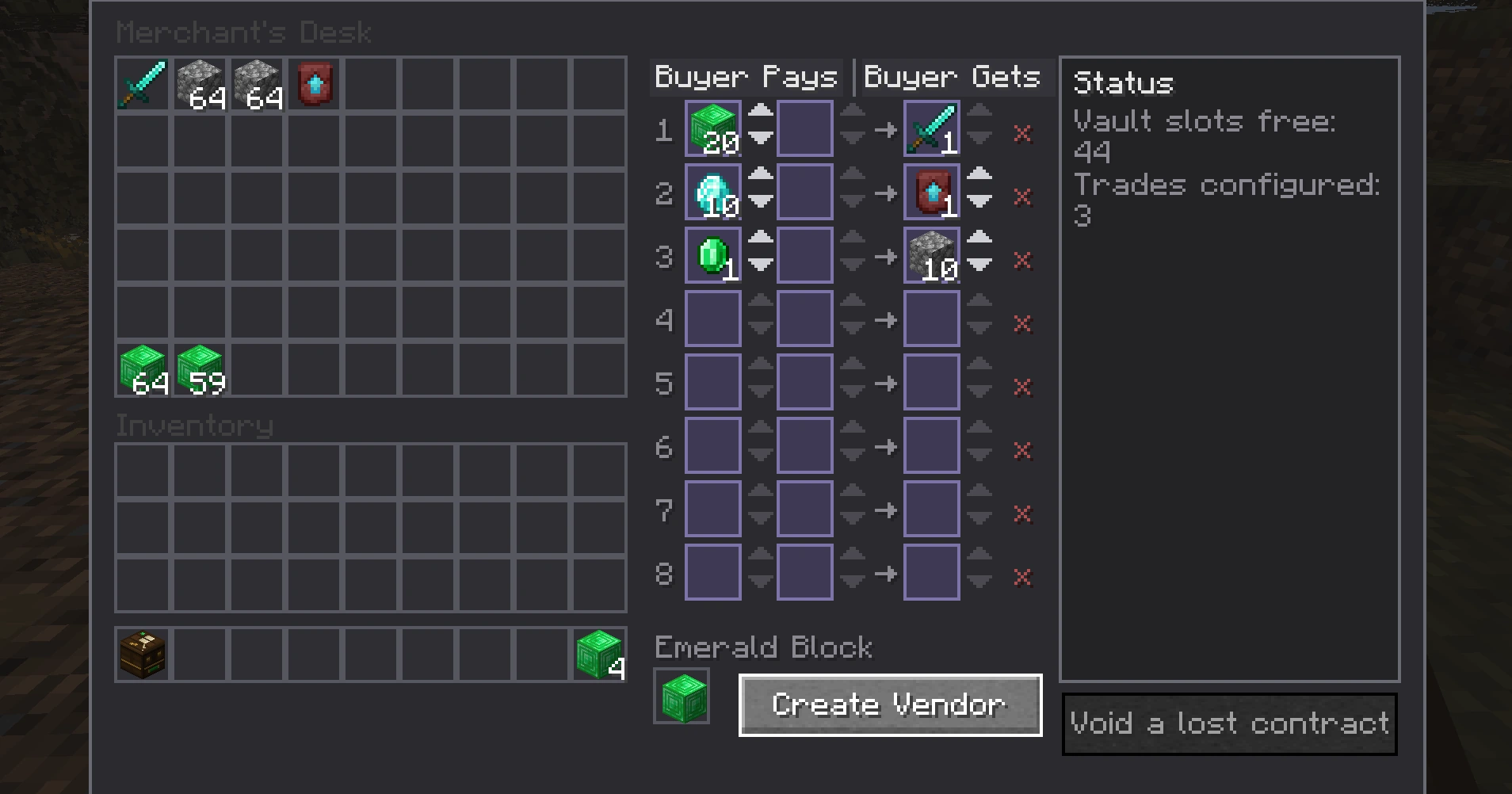
The desk is your whole shop in one block. Open it and you see your vault on the left and your price list on the right.
Your vault holds fifty-four slots and follows you everywhere. Open it from any desk in any dimension and your goods are waiting, whether you built that desk at spawn, in your base, or in the Nether. It is yours alone — no other player can see inside it or reach it, from any desk anywhere.
Set up to eight trades. Two payment slots each, so a price can be two iron and a stick rather than just two iron, with adjustable quantities on both sides. Sell a stack of cobblestone for a diamond, or one arrow for one emerald. Every item in the game is available, including items from the other mods you have loaded.
The recipe
Any wood variant works for the hanging sign. It is a deliberately late-game recipe, because the block grants unlimited cross-dimensional storage on top of the shop. The desk is hand-breakable and drops itself, and a second desk buys you another doorway rather than more storage.
The Factor
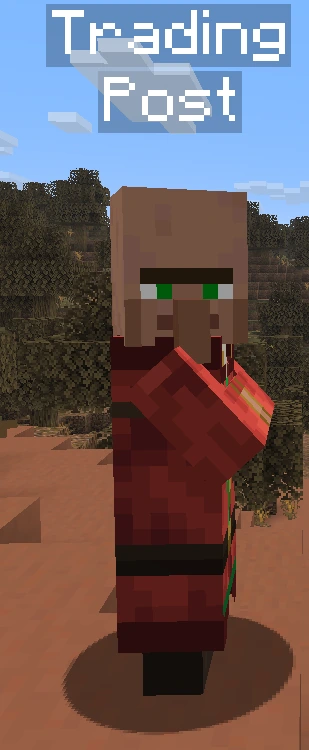
An emerald block hires a Factor: a merchant in a red coat who plants himself where you put him, watches customers as they walk up, and sells from your vault while you are somewhere else entirely. Your name floats above him, so a market of several shops stays legible.
He is not going anywhere. He doesn’t wander, panic, or get eaten. Mobs ignore him entirely, so a creeper can chase you straight through your storefront and leave it standing. Pistons, water, and knockback won’t move him either.
Nothing to loot. A player who really wants him gone can kill him — but he drops nothing at all, because everything he sells lives in your vault. Killing a shop is pure vandalism, never profit. You get a contract back for the days you had left.
Run up to three at once: one at spawn, one at your base, one at the market. Same stock, same prices, three storefronts. Each stands for seven days measured in world time, so a server switched off for a month costs you nothing.
Buying From a Shop
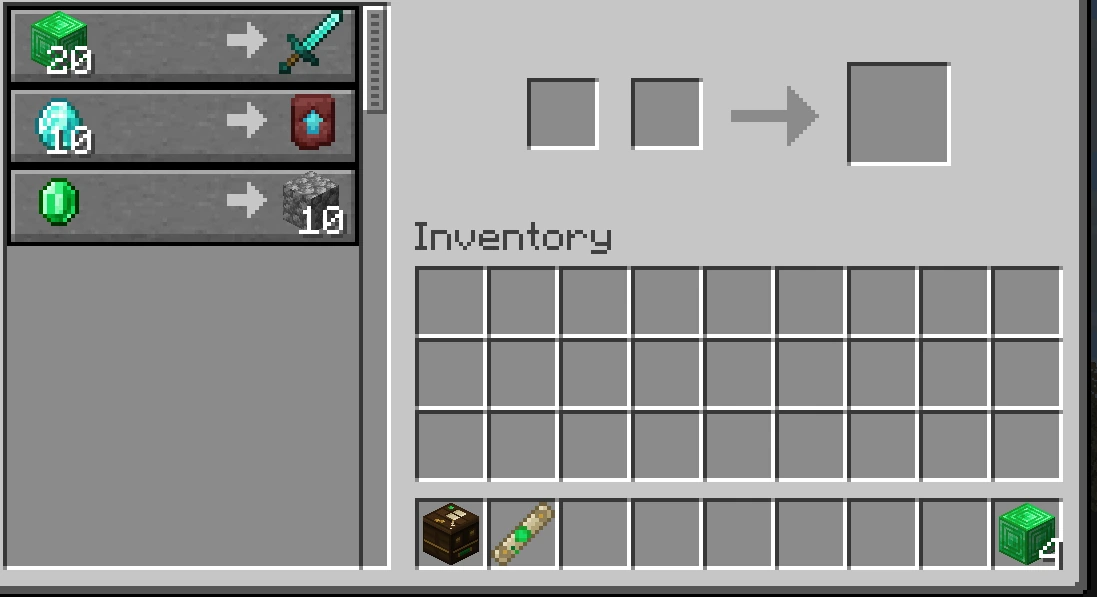
Buyers use the ordinary merchant screen, so there is nothing new to learn. Offers appear in the order the owner set them, and trades the shop can’t currently fund show greyed rather than vanishing — so a customer can see what a shop sells even when it’s out of stock.
Nobody buys the last item twice. Stock is re-checked against the live vault on every single click, so however fast people click, the goods either exist or they don’t appear at all.
Your good gear is safe. Only plain, undamaged items can be sold or used as payment. That enchanted sword sitting in your vault will never go out the door for two iron.
Getting Started
Craft a Merchant’s Desk
Two ender chests, three emerald blocks, a crafting table, and a hanging sign. Right-click it to open your vault.
Stock it and set your prices
Put what you want to sell inside. On the right, click Buyer Pays to choose what you want to be paid in, click Buyer Gets to choose what you’re selling, and use the arrows to set the amounts.
Hire your Factor
Drop an emerald block into the slot beside Create Vendor and press it. You’ll receive a contract. Right-click the ground where you want your shop, and your Factor appears, ready for business.
What You Get
- ◆Private 54-slot vault, reachable from any desk in any dimension
- ◆Up to 8 configurable trades, two payment slots each
- ◆Adjustable quantities on both sides, respecting each item’s stack limit
- ◆Every item in the game selectable, including modded items
- ◆Shops keep trading while you’re offline
- ◆Up to 3 vendors at once, sharing one trade list
- ◆Seven-day lifetime measured in world time — downtime costs nothing
- ◆Vendors are immune to mobs, immovable, and drop nothing when killed
- ◆A killed vendor returns a contract for the time that was left
- ◆Named nameplates, so a market of several shops reads clearly
- ◆Built to be dupe-proof, verified across hundreds of randomised transactions
For Server Owners
Every server wants a market, and every market dies the same way: nobody’s ever online at the same time. JRH Vendor fixes the schedule problem. Players set up shop once and their storefronts keep trading around the clock, so a spawn market becomes a place worth walking to instead of a row of empty stalls and abandoned chests.
Shops cost emeralds and expire after a week, so dead stalls clear themselves out and the market stays live. Vendors can’t be griefed for profit — killing one drops nothing at all — and the whole transaction system is built so items can’t be duplicated. Payment and goods move together or not at all, verified across hundreds of randomised trades including every failure route, with zero items created or lost.
Known Limits
Worth knowing before you build a market
- ◆All three of your vendors share one trade list. Separate prices per shop aren’t supported.
- ◆A buyer holds the shop for their whole visit, which locks out other buyers and your own desk until they leave.
- ◆Enchanted, damaged, and renamed items can’t be sold or used as payment. This is deliberate.
- ◆Contracts can only be placed by their owner, so shops can’t be gifted or traded.
Requirements
What you need
- ◆Minecraft Java 26.2 with Fabric
- ◆Fabric Loader 0.19.3 or later, Fabric API 0.152.0+26.2 or later
- ◆Java 25, on both client and server
- ◆No other dependencies
This is a Playtest
Found a bug? Got an idea? Just want to say what you think? The whole point is your feedback — bring it to the realm.
Tell us in the Discord